Saturday, November 10, 2012

"Lincoln" (2012)
d- Steven Spielberg
w-Tony Kushner - from a book by Doris Kearns Goodwin
dp-Janusz Kaminski

A
Steven Speilberg's new film, "Lincoln", opening wide next week, is one of his better films to date.
After the dissapointment of last year's "Warhorse", it seemed as though Speilberg had spiraled back into the vortex of Speilcrap.   Speilcrap is that awful brew of mawkish sentiment, overblown, contrived staginess, and awful 'lil cute kiddies that frequently attach to his films like barnacles and sink them totally. Early in the film, we are indeed subject to one - but only one- bit of Speilcrap (I'd say Speilshit, but this is a family blog). It comes in the first scenes, when Lincoln in reviewing troops and meeting with soldiers. Two little soldier twinks try to impress Lincoln by reciting, from memory - both of them - the Gettysburg Address. Music swells. The soldiers get about half way through and Lincoln basically tells them to bugger off. They do. Then, the John Williams goes into overdrive as a young black soldier, all voice aquiver, picks up where the twinks left off, with his battalion or unit, as they go skipping into the glittery sunset or whatever. My memory of this bit is admittedly a little murky, as I'm trying to blot it from memory. But oh please! Soldiers having a relatively recent Presidential speech committed to memory? In 1865? Really? Where did a soldier in the battlefield get access to the document?  Did they download the speech using Grandmaw's spinnin' loom? Whatever. Once it's passed, the movie quickly moves into best of Director's territory with an engrossing history lesson about what is to me anyway a little known bit of history.
In 1865, the U.S. Civil War was moving to conclusion, and Lincoln and his closest advisor, Sec. of State William H. Seward (He of Alaska's "Seward's folly), played brilliantly by David Strathairn, realized that the Emancipation proclamation was, as a wartime executive order, bound to expire when the war ended. In order to realize their abolitionist commitments, they needed to organize a constitutional amendment - it's 13th- to end slavery. And they needed to do it FAST, because if the ratification didn't come before the surrender, it never would. All support, tenuous as it was anyway, would evaporate as the war horror ended.
What follows is some fairly dense, but thoroughly engrossing delving into 19th century politicking. Eventually Lincoln, along with his political allies, such as fervent abolitionist Republican US House rep. Thaddeus Stevens, played by Tommy Lee Jones, carried the amendment to passage.

                        L to R ~ Daniel Day Lewis, Sally Field, and Joseph Gordon-Levitt

Along the way, courtesy of a master performance by Daniel Day Lewis, we are given glimpses of the Presidents private family life in the White House, his marital problems with his grief crazed wife, Mary Todd Lincoln, played by a devastating Sally Field, and his delicately sweet relationship with his young son, Tad, as well as his older, adult son, Robert. We are shown Lincoln's folksy, disarming humor, and his penchant for storytelling, with a couple of really good ones, that he used as a way of disarming his opponents. Lincoln's genius for coalition building, as they fought and lobbied to get the votes for passage, is portrayed, and we get to watch a group of lobbyists, using any tactic - even Tamany hall type bribery, to achieve the President's ends. Everyone used deception to achieve his ends, as happens still today, tomorrow and till the earth stops spinning.
Now about the performances. Every one of them was amazing. Lewis's performance I have already mentioned, and I'll predict an Oscar win. It's everything Oscar loves to honor. Deservedly so. And I'll say that I think that Sally Field  deserves another Oscar for her excruciating, devastating performance as Mary Todd Lincoln. It was everything I hoped it would be - and then some. I liked her. I really really liked her!
 Joseph Gordon-Levitt Plays the rebellious older son Robert effectively. He's most especially good in a scene where he witnesses the gruesome violence of war, replete with mangled, dismembered limbs dropped into a pit and covered with lye. That overall is one of the more memorable scenes in the film. Memorable also is the scene where Lincoln and Mary show down in an electric scene where she accuses him of blaming her for their young son's death three years previously and she completely breaks down in hysteria.
And Tommy Lee Jones is ....well... is the man even capable of a bad performance? is there no film he can not or will not steal?  A riveting, mesmerizing display as Stevens, a man who uses deception at a crucial moment in order to achieve freedom for millions.
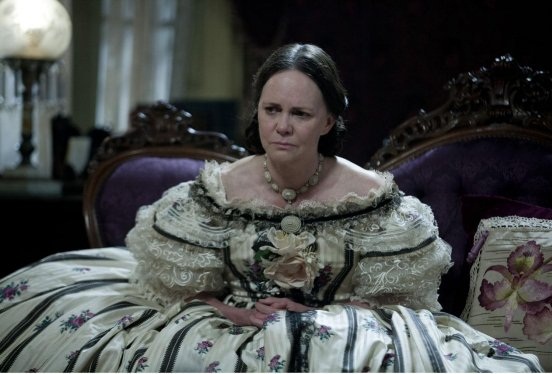
                                      Sally Field as Mary Todd Lincoln

                                     Tommy Lee Jones as Rep. Thaddeus Stevens

Also amazing was James Earle Haley as Confederate Vice President Alexander Stephens.
The list of top shelf performances is long.

Attention to period detail was extensive, and the art direction, makeup, wardrobe all was excellent. Kaminsky's camera was staid and unobtrusive, with some interesting compositional shots. There was an excessive amount of grain I noticed. I know Spielberg will never make the leap to digital shooting. He told me so Himself (shameless name drop). I saw a digital presentation, and the grain was a little distracting. What? did he shoot amamorphically, in 35mm?
A any rate, a fine picture, and a well written, meaty one. Light on the Spielcrap.

KISS OF DEATH


Damn, but Richard Widmark was awesome. He’s definitely in my top 10 favorite actors of all time. I just saw, for the first time, “Kiss of Death” (1947 d-Henry Hathaway) In it, Widmark plays Johnny Udo, a totally, completely, utterly psychopathic hitman. He plays the role to such black evil prefection that the role made him an instant star. Widmark himself said that it took years for him to exorcise the character from his head.
In the most memorable scene, excerpted below on YOUTUBE, Udo goes to the apartment of a suspected mob squealer, intent on killing him. When it becomes evident that the squealer has split, leaving his invalid mother behind, Udo decides to kill the old lady. Watch his face as he 86es her. TOTAL glee. Man, this is what cinema is all about, folks.
R.I.P. Mister W.
http://www.youtube.com/watch?v=FHHJsXH3BiU


“The Ox Bow Incident”

“The Ox-Bow Incident”
w-Lamar Trotti d- William Wellman


Henry Fonda and Harry Morgan play two drifter cowboys who blow into town just as a local rancher is found to have been murdered and his cattle stolen.This rancher was well loved in town, so the local townsfolk form a posse, which quickly turns into a lynching mob, bent on revenge for their friend’s death.They come upon three transients in the wilderness and quickly assume them to be the guilty parties, and make ready to hang them. Conflict comes when several of the posse, including Fonda and Morgan, who have fallen in with them, voice objections to the apparent lack of due process, particularly since to anyone with a rational mind, it’s clear that these men are anything but guilty of the crime. Unfortunately, the mob posse is headed by a bloodthirsty deputy, a failed phony civil war officer, who’s trying to compensate for his son’s obvious homosexuality, and an uber butch cowgirl dyke from hell, played by Jane Darwell (Ma Joad from “The Grapes of Wrath“), Who’s only interested in hangin’ the bastards, guilty or not.
Through the everyman character of Fonda, it puts its audience into the dilemma of what to do when you know what’s happening is dead wrong. Will you face the possibly deadly consequences of opposing the mob? Or will you acquiesce, assuming that there’s nothing you can do to stop it?Dana Andrews plays the bewildered head of the little group of drifters who protests his utter innocence and only asks for time to write his wife a note of farewell before they force the noose on him.
(spoiler)
In the end, sanity fails and the men are hanged, only to have the Sherriff ride up from town (he was away when they rode out) to tell them that the thieves have already been caught and confessed.In the final, powerful scene, the horrified, guilt ridden mob posse are assembled in the saloon, awaiting their fate. Fonda pulls out the letter that Dana Andrews had written to his wife and reads it to the stricken group.
William Wellman directed the extremely economic and tight script, and he was a director known for a tremendous social conscience. The Black and White photography is some of the best I’ve seen. Why is this film not a better known classic? Well, for one, it bombed at the box office.  Made in 1941 and released in 1942 -after the outbreak of WWII – audiences were really not in the mood to be preached to about restraint of anger. Darryl Zanuck sensed this and didn't promote this film at all. it slipped off the radar and was buried for many years. Pity. It’s a great film, one I’m glad to have in my collection.

“The Manchurian Candidate” – a photo study

“The Manchurian Candidate” 1962
D- John Frankenheimer
W- George Axelrod
D.P.- Lionel Lindon

 dream sequence: juxtaposition

I‘m going to reprint a brief plot synopsis of the film, but my main focus will be to highlight a few of my favorite pictorial moments from the film, and to discuss a few plot points, and how they relate to the novel by Richard Condon, which I’ve just read. The sections in boldface are by film critic Roger Ebert. The rest is mine.
So here we go.


“The picture plays some wonderful, crazy games about the Right and the Left; although it’s a thriller, it may be the most sophisticated political satire ever made in Hollywood.”
– Pauline Kael, 5001 Nights at the Movies (1992)
“…The Manchurian Candidate was a bold venture in 1962, with its flashy technique and political themes. Now re-released…its mobile camera and fluid editing still dazzle. And its story of Cold War intrigue, murky East-West dealings, assassination, brainwashing — and the idea of a glorified cue-card reader playing president — resonates today like never before.”
– Desson Howe, Washington Post (February 12, 1988)
“Here is a movie that was made more than 25 years ago, and it feels as if it were made yesterday. Not a moment of The Manchurian Candidate lacks edge and tension and a cynical spin. And what’s even more surprising is how the film now plays as a political comedy, as well as a thriller… For more than 25 years, memories of The Manchurian Candidate have tantalized those who saw it at the time…
“Was it really as good as it seemed? It was.”
– Roger Ebert, Chicago Sun Times (March 11, 1988)


The title of “The Manchurian Candidate” has entered everyday speech as shorthand for a brainwashed sleeper, a subject who has been hypnotized and instructed to act when his controllers pull the psychological trigger. In the movie, an American patrol is captured by Chinese communists during the Korean War, and one soldier is programmed to become an assassin; two years later, he’s ordered to kill a presidential candidate. That such programming is impossible has not prevented it from being absorbed as fact; this movie, released in 1962, has influenced American history by forever coloring speculation about Lee Harvey Oswald. Would the speculation about Oswald’s background and motives have been as fevered without the film as a template?
The film has become so linked with the Kennedy assassination that a legend has grown up around it. Frank Sinatra, the film’s star, purchased the rights and kept it out of release from 1964 until 1988, and the story goes that he was inspired by remorse after Kennedy’s death.  Sinatra says it was the high point of his acting career; nobody mentions why it was unseen for 24 years.
Seen today, “The Manchurian Candidate” feels astonishingly contemporary; its astringent political satire still bites, and its story has uncanny contemporary echoes. The villains plan to exploit a terrorist act, “rallying a nation of viewers to hysteria, to sweep us up into the White House with powers that will make martial law seem like anarchy.” The plot cheerfully divides blame between right and left; it provides a right-wing demagogue named Sen. John Iselin, who is clearly modeled on Sen. Joseph McCarthy, and makes him the puppet of his draconian wife, who is in league with foreign communists. The plan: Use anti-communist hysteria as a cover for a communist takeover.- Roger Ebert
In fact, the whole Right wing McCarthy paranoia of the late 1950′s is deftly skewered in this film. The Iselins are portrayed as obvious right wing demagogues. There is even a scene where the Iselins are argueing over dinner about how many communists that Senator Iselin is suppose to say are in the state department. Iselin is totally controlled by his wife. He’s nothing more than a moron puppet for her power mad ambitions. He’s too dim to remember a number himself, so she, with obvious revulsion, notices the ketchup he’s plowing onto his steak. In the next scene, The idiot Senator says that there are 57 varieties of communists in the state department. How’s that for product placement?


Another interesting use of visual symbolism used in the film is the presence of Abraham Lincoln iconography whenever we see the Iselins. Their various homes and offices are filled with Lincoln, as you can see in the visual exhibit below. Frankenheimer obviously wanted it clear which side of the political spectrum his villains were coming from. In former times, Lincoln was the primary symbol of the Republican party.


The film trusts its viewers to follow its twisting, surrealistic plot, especially in the way fragmented memories of the Korean brainwashing leak into the nightmares of the survivors of that patrol. A flashback shows us what happened: After being hypnotized by their Chinese captors, they think they’re attending a meeting of a garden club in a New Jersey hotel, while we see their communist hypnotist lecturing a room of other party officials. To show how strong the programming is, he orders Staff Sgt. Raymond Shaw (Harvey) to strangle one of the Americans and shoot another; the film’s point of view cuts freely between the different versions of reality.-Roger Ebert

 The dream sequence


The dream sequence was one of the most amazing pieces of virtuosity film editing ever done. According to Frankenheimer, they shot the same scene four times, with four different combinations of circumstance. there was
·        #1 the actual incident, in the Manchurian amphitheatre with Yen-lo, the Chinese psychiatrist/brainwasher, and the Chinese and Russian military brass.
·        #2 the brainwashed platoon with the imaginary ladies garden club in New Jersey
·        #3 the brainwashed platoon with the new jersey garden setting, replacing the ladies with Yen-lo and the Russians and Chinese
·        #4 the brainwashed platoon juxtaposing yen-lo/Russian and Chinese personnel with Black New Jersey ladies (representing the Black platoon member’s nightmare)
Frankenheimer gave the initial editing attempt to  George Axelrod, the writer, who assisted Film editor Ferris Webster and together they hammered out a dream sequence that seamlessly switched back and forth between versions of reality that was and is astounding. Frankenheimer never changed that initial edit. It was that perfect.
Back in the United States, Raymond is given the Medal of Honor and greeted by his smothering mother (Lansbury) and her second husband, the weak, alcoholic Sen. Iselin (James Gregory). It’s a running gag in the film that Raymond is constantly referred to as the senator’s son, and keeps repeating, “I am not his son.” Mrs. Iselin has incestuous feelings for Raymond, which in the novel lead them to bed, but in the movie are revealed through a famous full-lip kiss. Raymond hates her, hates himself and has a bitter speech about how he is not lovable.
Sinatra plays Maj. Bennett Marco, another member of the Korean patrol, whose fragmented nightmares lead him to suspect the brainwashing. He leads an Army investigation that determines Raymond may have been programmed as an assassin — but crucially fails to bring him in for questioning, because he believes Raymond’s romance with Jocelyn, daughter of a liberal senator, may cure him. The climax plays out inside Madison Square Garden, where Mrs. Iselin has ordered her son to shoot her party’s presidential candidate during his acceptance speech; Sen. Iselin, the vice presidential candidate, will catch his falling body and then, she says, deliver “the most rousing speech I’ve ever read. It’s been worked on, here and in Russia, on and off, for over eight years.”-Roger Ebert
(spoilers!)
Marco gets to Raymond and smashes his mental programming, allowing Raymond to shoot and kill his Mother and the Senator instead.
The assasination scene, pictured below, is one of the most realistically filmed scenes in movie history. It’s extremely creepy how the shaky, cinema verite look foreshadowed the Zapruder film of Kennedy’s assasination and the Assasination of Lee Harvey Oswald.


the assasination sequence

The film moves freely between realism and surrealism. Frankenheimer shows Iselin at a press conference and Senate hearing, with details lifted directly from the Army-McCarthy hearings; as Iselin waves a list of “card-carrying communists,” TV sets in the foreground show the same scene being carried on the news. Yet other scenes are from Raymond’s disturbed point of view, especially when his hypnotic trigger (the Queen of Diamonds) appears in a solitaire game. There’s a scene where Sinatra’s character holds up a deck full of queens while trying to deprogram Raymond; it’s a little out of focus, and Frankenheimer confesses on the commentary track that although Sinatra supplied several other takes, they weren’t as good, so he went with the flawed one, only to be praised for the unfocused shot showing Raymond’s disturbed perceptions.-Roger Ebert


Angela Lansbury’s portrayal of Mrs. Iselin was nominated for an Oscar. It is, in my opinion, one of the greatest slights in movie history that she lost it. Completely unforgivable. I’m sure that Patty Duke is wonderful in “The Miracle Worker”, but please! Lansbury so inhabits Mrs Iselin and informs her every move with such malevolence. It’s a performance which works on multiple levels. There’s so much unspoken emotion going on in her face, and in her body language. She seeths and exudes such evil. 
 Fierce, focused, contemptuous of the husband she treats like a puppet, she has, we gather, plotted with the Russians and Chinese to use the Red Scare of “Iselinism” to get him into office, where she will run things from behind the scenes. But it comes as a shocking surprise that her own son has been programmed as the assassin. That so enrages her that, in another turn of the corkscrew plot, she tells him: “When I take power, they will be pulled down and ground into dirt for what they did to you. And what they did in so contemptuously underestimating me.”-Roger Ebert


Frankenheimer uses a heightened visual style to underline the byzantine complexity of his story. There are tilt shots, odd angles, and the use of deep focus for his favorite composition, in which a face is seen in closeup in the foreground while action takes place behind it in the middle distance.


This look is matched by Axelrod’s dialogue, which often jumps the tracks of reality. Consider the peculiar first meeting between the Sinatra character and Rosie (Janet Leigh), who will become his fiancee. He’s so shaky on a train that he can’t light a cigarette. She follows him to the platform between cars, lights his cigarette, and then says, “Maryland’s a beautiful state.” “This is Delaware,” Sinatra says, and she replies: “I know. I was one of the original Chinese workmen who laid the track on this stretch. But nonetheless, Maryland is a beautiful state. So is Ohio, for that matter.”


Soon she has broken off an engagement and taken up with Marco, leaving us to wonder what in the hell that dialogue was about. Was it in code? Was Marco hallucinating? It seems strange that the Chinese brainwashed the entire patrol, but needed only Raymond as an assassin. Why, then, spare the others with their nightmares and suspicions? Is Sinatra’s Maj. Marco another Manchurian sleeper, and is Rosie his controller? If you look at their scenes carefully, you find that she broke off her engagement immediately after their awkward train meeting and before their first date. Reflect on the scene where she talks about Marco beating up “a very large Korean gentlemen,” and ask yourself what she means when she calls this man, who she has never seen, “the general.” I don’t know. Maybe Rosie just talks funny. It would be a nice touch, though, for this screwball story to have another layer circling beneath.-Roger Ebert
In the book, Rosie is clearly not a sleeper agent. In fact, her odd behavior is never really explained, but one weird bit of dialogue is. When he first meets her on the train, Marco asks her “Are you Arabic?” Now, it’s really strange for him to be asking the very white, W.A.S.P.ish Rosie as portrayed by Janet Leigh this. It leads you to suspect it may be some kind of subconcious pre-planted code. In the book, however, Rosie is described as having extremely sharp,exotic arabic features. So that explains it.Frankenheimer should have deleted that line, as it only served to confuse the viewer.

The Manchurian Candidate” is inventive and frisky, takes enormous chances with the audience, and plays not like a “classic” but as a work as alive and smart as when it was first released. “It may be,” Pauline Kael wrote at the time, “the most sophisticated satire ever made in Hollywood.” Yes, because it satirizes no particular target — left, right, foreign, domestic — but the very notion that politics can be taken at face value.

“The Grapes of Wrath”

The best Motion picture that has ever been or ever will be made

“The Grapes of Wrath” (1940)
w-Nunally Johnson -from the novel by John Steinbeck
d- John Ford

 opening.jpg
 the opening shot

In 1939, John Steinbeck published his masterpiece, The Grapes of Wrath, and immediately, it stirred up enormous controversy because of its volatile subject matter. The book was banned throughout most of the Midwest and the central valley of California, and he was branded as a commie pinko by the right wing. Darryl Zanuck read the book and was electrified and immediately bought the film rights. The rest is cinematic history.

THE STORY
The Grapes of Wrath is the story of the Joad Family, a poor family of sharecroppers in 1930′s Oklahoma who, like thousands of others are forced off of their farms and into the road because of the great “dustbowl” drought of the 1930′s. But as Steinbeck illustrates, that was not the only reason for these people’s displacement. The banks and big agriculture used the drought as an opportunity to buy up huge parcels of land and bulldoze the small farmers off so that they could move in and build our modern corporate conglomerate super farms. ConAgra. That sort of thing.

Henry Fonda as Tom Joad
 Henry Fonda as Tom Joad

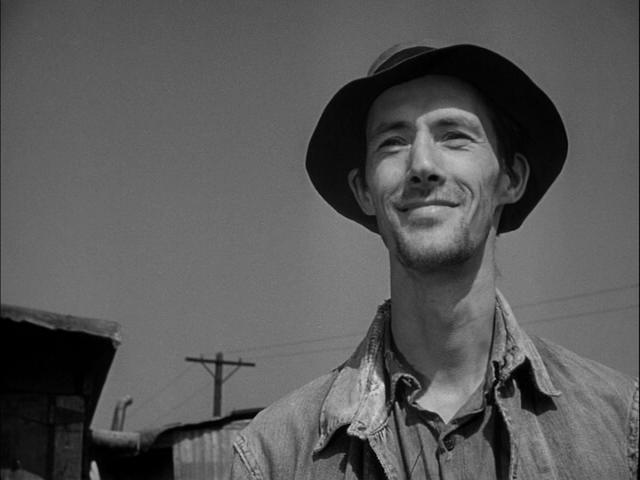
Henry Fonda plays Tom Joad, who’s returning from a four year stint at Mcallester Prison where he was serving time for homicide. Four years earlier, he’d picked up a shovel and whacked a guys head “plum to squash” for sticking him with a knife in a fight at a dance. He was parolled after serving four years of his sentence.
On the road home, he runs into Jim Casey, the town preacher. Casey is homeless and wandering, having lost his faith and his flock.He no longer has anything to preach about, because he’s lost his faith in people and god, and he’s trying to find his way back, to find some meaning for his life. He throws in with Joad and they both make for the Joad farm.

John Carradine as Jim Casey
John Carradine as Jim Casey
They come upon the Joad farm at dusk. It’s dust blown, dark and abandoned. They’re all dead or gone, Joad says, crestfallen.

fonda_grapes_of_wrath.gif
Tom and Casey in the abandoned Joad cabin
In the empty house, they find Muley, one of their neighbors who’s gone feral and mad, living in the brush and abandoned houses of the countryside. Muley tells Tom that they’ve all gone and left. He explains (in flashback) how the Corporations and banks who held title to the farms have forced all of their friends and neighbors, including his own family, into the road. Muley remained behind, unable to leave the land his family had held since his ancestors, the pioneers who tamed the west, came there and built their farms.
Muley and his family watch in horror as their home is flattened by the “cat”-caterpillar tractor
After leaving Muley, they catch up to the Joads, who have been staying at their uncle John’s place. Since he also has been evicted, they are all preparing to leave and head west to California, where a handbill that’s been circulating around is advertising 800 jobs picking peaches in the San Joaquin Valley. They’ve scraped together $200.00 and bought an old truck and loaded it up with everything they own. Tom and Casey join them and Ma Joad, overjoyed at the unexpected reunion with her eldest son, is saddened still at the prospect of leaving her home for an uncertain future for her family. “I never had my house pushed over before. Never had my family stuck out on the road. Never had to lose everything I had in life. “
 
Jane Darwell as Ma Joad
The family sets out From Sallisaw, Ok, and makes their way onto route 66 and heads west, past hostile roadhouses, gas stations and government agricultural checkpoints. Finally, after passing through the oppressive Arizona desert at night, they reach Needles, California. At Barstow, Grandma dies, disconsolate and depressed at the earlier loss of grandpa, who had a stroke just after the outset of the trip. The move from his home was too much for him.
Route 66 sequence


They reach Bakersfield, and are advised that the handbill that they’ve pinned their hopes on is in actuality a scam that has been sent out to lure as many itinerant migrants to the Central valley as possible. The more people that come, the lower the wage they have to pay, due to the glut of available slaves workers.

They are told to move immediately to one of the many “hoovervilles”- shanty towns that clustered around the cities at that time. There, they see first hand squalor and poverty unimagined to them. They (and we) see Dorothea Lange’s Depression conditions up close.

 two views of the “hooverville” shantytown


An agent from one of the big Tulare County farms tries to con the men into coming out with him to pick peaches. When a suspicious migrant balks when no wage amount is promised, he’s branded an agitator and flees the goon cop who’s acting as an enforcer for the labor contractor. The goon cop shoots at him, hitting a woman bystander. In one of the most powerful and disturbing moments in the film, an elderly, bespectacled lady, cradling the bleeding woman in her arms,  looks beseechingly up at the cop.”This lady’s bleeding to death” she says. The cop looks impassively down at her and says “Yeah ..Boy, what a mess them .45′s make”

Pa Joad (Will Simpson) and Casey watch the shooting

Casey gives himself up as the culprit of the revolt so the cops won’t possibly question Tom and find him in violation of his parole. Casey is taken away in handcuffs and the Joads leave the Hooverville shantytown to escape the police harassment that is happening as a result of the shooting.
They are told on the road that there’s a ranch nearby in Pixley that needs pickers. They go there and are met by confusion as hundreds of people, for reasons unknown to them are in a near riot outside the ranch gates. They are escorted by cops with clubs through the mob and when they ask what’s going on, are told brusqely to mind their business and not ask questions. After being assigned a ratty little piss tank of a cabin to live in, they hit the fields to pick peaches.
Later, Tom, who’s been trying to find out what the commotion at the gate was, decides to look around and get some answers. He soon is made to realize that they are virtual prisoners in the camp and is told by the capo to go back to his cabin and shut up or he’ll be whacked.
He escapes in the darkness and comes upon a campsite of refugee workers. These workers, the same folks rioting at the gate, are striking the ranch because their wages have been cut back. They now don’t make enough to survive on. Joad then discovers Casey there with them. Casey,who was released by the cops, is the man who’s been organising them to strike. He’s found his true self and calling amongst the unrepresented, disenfranchised migrants and has dedicated himself to helping them and theirs in fighting for a fairer, better life for themselves. For the first time in years, he is truly happy, and in his element. He’s found his call.
They are found by the cops and Casey, pleading with the cops not to cut their wages and starve the children, is quickly overpowered and brained to death. Tom witnesses this and in a blind rage grabs the club from the cop and cracks his head wide open. Again, “plum to squash.”
An injured Tom flees back to the cabin and the family flees once again, this time with cops after Tom, who has indeed killed the cop.
They head north on the 99 and find the Shafter/Arvin Government worker’s camp. This place is a comparable paradise where the migrants live in decent, clean campsites and make their own rules and govern themselves. Run by a man named Tom Collins (may he rest in evelasting peace), they are allowed the dignity they deserve.

 
Grant Mitchell as Tom Collins. The real Collins was a consultant on the picture.

Eventually, the authorities have caught up and are closing in to where Tom is hiding, and he must go on alone. A distraught Ma volunteers to hide him, but Tom will hear none of it. He must move on alone and risk their entanglement with him no longer.

But Tommy, how will I know if you’re alive or dead? How will I find you? How will I know?” 

TOM JOAD:Well, maybe it’s like Casy says. A fellow ain’t got a soul of his own, just little piece of a big soul, the one big soul that belongs to everybody, then…
Ma Joad: Then what, Tom?
Tom Joad: Then it don’t matter. I’ll be all around in the dark – I’ll be everywhere. Wherever you can look – wherever there’s a fight, so hungry people can eat, I’ll be there. Wherever there’s a cop beatin’ up a guy, I’ll be there. I’ll be in the way guys yell when they’re mad. I’ll be in the way kids laugh when they’re hungry and they know supper’s ready, and when the people are eatin’ the stuff they raise and livin’ in the houses they build – I’ll be there, too.
Ma Joad: I don’t understand it, Tom.
Tom Joad: Me, neither, Ma, but – just somethin’ I been thinkin’ about.

In the end, after Tom has gone, the family once again is moving on. Pa has heard of an offer of a month’s work up in Fresno, so they set off. The final scene is in the truck, as Ma and Pa are reflecting on all the hardships they’ve been through and Pa admits he cant go on much more.
Well, Pa, a woman can change better’n a man. A man lives sorta – well, in jerks. Baby’s born or somebody dies, and that’s a jerk. He gets a farm or loses it, and that’s a jerk. With a woman, it’s all in one flow, like a stream – little eddies and waterfalls – but the river, it goes right on. Woman looks at it thata way.

[last lines]
Ma Joad: Rich fellas come up an’ they die, an’ their kids ain’t no good an’ they die out. But we keep a’comin’. We’re the people that live. They can’t wipe us out; they can’t lick us. We’ll go on forever, Pa, ’cause we’re the people.
(thanks, IMDB!)

MY FEELINGS ON THIS FILM
Wow ,this film touched me on so many levels. I saw it for the first time just this last December 23rd (2006), the morning before heading up the I-5 home for Christmas. I’d bought it several days earlier while xmas shopping. It was a $9 dvd, so I thought ‘what the hell’.
Not since Atticus Finch have movie characters moved and inspired me so deeply as both Tom Joad and Jim Casey did. These are true heroes to me. Ma Joad, too. They were beautifully simple and true and stood for what they loved and believed in. This picture gives me goosebumps just thinking about it.
I do not see this as a relic of the past to be viewed as ancient and done history. With the current controversy and hatred towards hispanic migrant workers, it’s still happening. The Arvin camp is still there, still in use. In fact, the buildings used in “The Grapes of Wrath” are still there.
 True, the “okies” were U.S. citizens, but they were treated just as harshly as today’s illegal immigrants are. The movie underplayed what happened to many who tried to pass the Arizona/California border at Needles. They were beaten and jailed, many of them. The starvation rate of migrant workers was so severe that hundreds died in boxcars and tents all along the I-99 corridor in the central valley. There must be many, many unmarked shallow graves there still.
Darryl Zanuck, the 20th Century -Fox producer, had a hard time getting this film to the screen. there were many, many protests, mostly from the right wing. They saw this as a subversive film. Well of course it was! Anything that challenges the unjust status quo is and was subversive, and damn good for it.
They saw it as a communist propaganda piece and I must admit that after it was over, I said to myself ’holy crap! A major movie company made a blatanly pro socialism movie in 1940!’ Which it was in a way, but the Arvin camp, and (too few)  others like it were works of Roosevelt’s new deal. They were run by the U.S. Dept of agriculture. So in portraying those camps, you could hardly make a reasonable arguement that the filmmakers were pushing communism. But whoever said that right wing noisemakers were ever reasonable?

JOHN FORD AND THE PRODUCTION OF THE MOVIE

Irony on the I-99 ~ a 1940 photo of a billboard advertising the movie in the very same place the story happened. Note the migrant tents in the background.

John Ford directed this film with great care and precision.  All of the elements – acting, directing, photography, editing and score came together as few films in  history ever have.
In the early 1950′s, “Citizen Kane” came to be considered as the greatest American film ever made, due in large part to it’s revival on the student film circuit. Prior to that, “The Grapes of Wrath” held that position. Both films were produced roughly within the same 2 year time period, with Kane being produced at R.K.O.  in 1941. Both films were also photographed by the great Gregg Toland. His groundbreaking, brilliant work contributes immensely to the greatness of both films. Look at the pictures in this posting and see his compositional genius.
The score, which is very, very sparse, themes “Red River Valley” throughout. However, 98 percent of the film has absolutely no dramatic underscoring, which lends greatly to the realism of the piece. Ford used a single mournful accordion. On all of his pictures while shooting, he always used the same accordionist on set to create the mood between takes. One guesses that it was during those times, while playing “Red River Valley’ that Ford got the idea to use it in the film. No existing record proves that, however.
In terms of realism, this film was 50 years ahead of it’s time. It pulled no punches in portraying the reality of the horror. In fact, Steinbeck himself praised the film highly and said that Hank Fonda brought more life to Tom Joad than even his book did. Years later, in 1961, Steinbeck wrote to Fonda and said that he’d just recently seen Wrath again, courtesy of a bootleg 16mm print, and told him he was still deeply moved and impressed all those years later.
I plan to follow the journey of the Joads this summer. I’m going to take my camera and visit those camp locations in the Central Valley and on the 99 and see if I can’t find some relics of the okies myself. I and my group of buds at the eagle go camping out there on the King River every summer, and I’ve passed those places many, many times without realising their cultural, historic significance

“Sunset Blvd”

I originally wrote this piece for  IMDB in 2004. I want to archive it here. Enjoy!   ".... MAX?!!"

I just want to clear up a misconception about Gloria Swanson and her performance as Norma Desmond in “Sunset Blvd”.
Gloria Swanson was NOTHING like Norma Desmond in real life. At the time she was offered the role, she was very busy (thank you very much) in New York with, among other things, pioneering early live television. She had a very busy family and social life, and wasn’t that keen on returning to California and the silver screen.
She was, however, very intrigued with the script, and was talked into it by Billy Wilder.
When she got to the coast and began to make contact with some of her old friends from the silent days, she was very disturbed and a little freaked out to discover that there were indeed many “Norma” cases hidden in the Bel Air hills. She was shocked to find many of her old acquaintances were stuck in the past, whereas she had moved on and never looked back. She then actively sought out these people and began studying them, incorporating parts of each of them into her portrayal of Norma Desmond. 

A couple of interesting stories about the making of this movie are worth relating.
In 1948, Billy Wilder and his collaborator, Charles Brackett were searching for story ideas. They were lunching at Chasens restaurant in Beverly Hills and Wilder noticed an aged, apparently “homeless” man hovering around C.B. Demille’s table. Wilder observed DeMille motioning the old bum over and whispering something to him. The bum shuffled out. Intrigued, Wilder filed the incident away. Several days later he ran into De Mille on the
Paramount lot and asked about it. “Oh yes, that was old Griffith asking for work again.” Aghast, Wilder asked “
Griffith …WHO?”
 “D.W. Griffith” Demille simply replied, and walked away.
It so shocked Wilder that such a titan of the film industry could become such a severe has –been, could have fallen so low. It gave him and Brackett the germ of the idea that eventually became “Sunset Blvd”-the true, unvarnished look at how Hollywood treats its “living legends”.
Another interesting story occurred at the film’s Hollywood première. It was, of course a huge, star-studded affair. Everyone who was anyone was there. After the screening, L.B. Mayer, then recently deposed head of MGM and one of the most powerful of all movie moguls stormed into the lobby, where Billy Wilder was holding court, ravishing in the praise from all. “You muckraking scum! You’ve ruined this town with this filthy picture! You and your kind are ruining our industry!” Mayer barked in Wilder’s face. Wilder, with an ever so faint smirk on his face clucked his tongue and said “Mister Meyer? Go f@ck yourself”
And that, ladies and gentlemen, was Mr. Billy Wilder.

“SPARTACUS”

“Spartacus” (1960)
w- Dalton Trumbo, Peter Ustinov
 from a novel by Howard Fast
d- Stanley Kubrick, Anthony Mann
dp-Russell Metty, A.S.C.
I‘d never seen this picture until this last weekend. The subject matter never particularly appealed to me, although I count the similar “Ben Hur” amongst my favorite pictures of all time. Perhaps one of my 10 favorites.
Now, I have a new one.
sparta1.jpg
Spartacus (played amazingly by Kirk Douglas) was, according to Roman historians, Chief among them Plutarch, a Thracian slave laborer who lived in the last century before the birth of Christ, about 70 B.C. Thrace is now modern day Bulgaria. He was sold into gladiator training in a Roman school near Capua (Naples). He led a revolt of the school, the Gladiators broke out, burned it down, and started a slave uprising that spread all across Italy, shaking the foundations of Roman power and authority . By the time they were defeated two years after the revolt, they numbered an estimated 60,000 rebels.
I was not at all prepared to be so profoundly moved by the devastating conclusion. I didn’t know the story at all, and I was wrecked emotionally by the time the lights came up. It is a tremendous story of struggle, and horrible loss and defeat. This is not a story with a happy ending. Everyone dies horribly. The Noble struggle was doomed before it ever started. The heroes know that this is the only conclusion possible long before it happens. But the struggle and loss is better to them because they know that they they will die free,  and not as slaves, stripped of all dignity and humanity. Spartacus was a man who dreamed of the end of slavery 2000 years before it would finally end in the American south in 1865.
(SPOILERS!)
Man, the ending is just devastating. The slave army, consisting of Men, women and children, is finally brought to bay and vanquished by Marcus Licinius Crassus (Lawrence Olivier), the ambitious Roman senator and commander of the Roman legions. He slaugters all but 6000 of the men, who are given a choice by Crassus of either delivering Spartacus to him, living or dead, and being freed -or immediate crucifixion. The scene where Spartacus stands and his “I am Spartacus” is drowned out by every other captive standing and proclaiming himself to be Spartacus is one of the most moving moments in cinema history.

sparta3.jpg
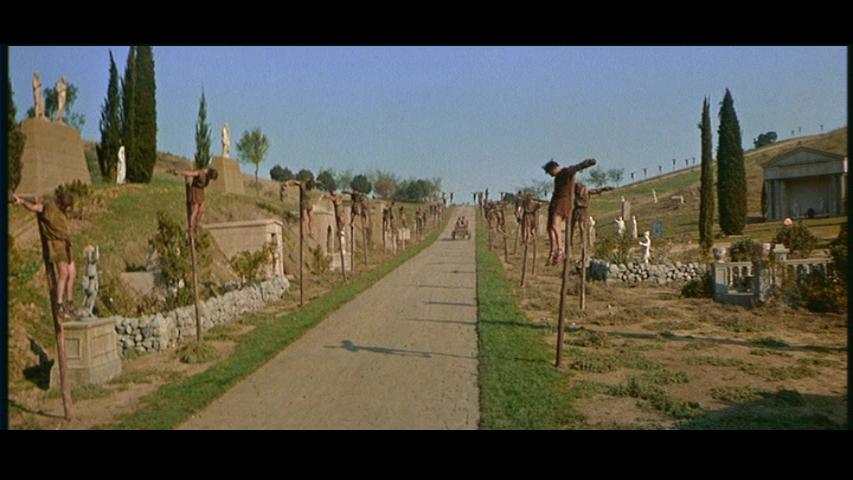
The last scene, one second before the final fade out. 

History records that Crassus had all 6000 men crucified, and their bodies hung on crosses which lined the Appian way, from Naples all the way to the gates of Rome.
Spartacus and Antoninus (Tony Curtis) are spared to be the last to die, where Crassus makes them fight to the death for his pleasure. Antoninus was Crassus’s unwilling boy concubine, and Crassus picks him to die last out of spite for having been rejected.
                                                   ANTONINUS: (quietly)
                                           Are you afraid to die, Spartacus?
                                                    SPARTACUS:
                                          No more than I was  to be born
                                            ( 3 beats)  Are you afraid?
                                                        (pause)
                                                  ANTONINUS (softly)
                                                         Yes.

The scene where Antoninus dies in Spartacus’s arms and they declare their love for each other was devastating. As he dies, Spartacus tells him softly to “go to sleep.”
sp16.jpg
“Go to sleep”

Spartacus is crucified, and at the end, as she is escaping, his wife comes across him, as he’s dying on the cross. She shows him his newborn son, freed along with herself, and the final frames of the film are of her, desperate, crying, begging him to die, to please die quickly. His dying eyes gaze for the one and only time at his son.


sparta2.jpg

The Producer, Edward Lewis, relates that the Christianist nutjobs flipped out with the crucifixion scenes. They screamed that it was blasphemous. To his utter incredulity, he came to realize that the morons evidently thought that crucifixion was a death that was exlclusive in history only to one man, Jesus.
 God, they were - and still are- as clueless and dumb as a box of rollerskate wheels.


sp9.jpg

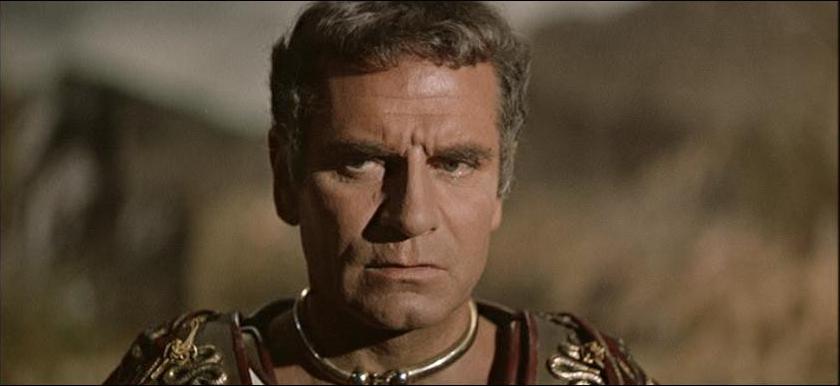
Sir Laurence Olivier as Crassus, who, as history paints him, could really give Hitler a run for his money as one of the most vicious despot/killers of all time.
Olivier gives an excellent performance. Subtle, nuanced. You can see the wheels turning behind his eyes.

sp10.jpg
The superb, incandescent Peter Ustinov(Right) as Lentulus  Batiatus, the owner of the Gladiator school where Spartacus and the other insurgent slaves initially revolt. Many of his best lines were improvised by the actor himself, who was also a gifted writer with an amazing ear for dialogue. His scenes with Laughton are as rich and smooth as a fine port wine.
 Charles McGraw gives a chilling, unforgettable performance as Marcellus (left) the sadistic “headmaster” of the school. During the revolt scene, Douglas accidentally broke McGraw’s jaw when he improvised on  the spot to slam McGraw’s head into an iron cauldron of boiling soup. McGraw’s jaw was slammed into the rim of the cauldron.

sp15.jpg
The great Charles Laughton plays the Senator Graccus, who is intriguing against Crassus in the Roman senate. He transfixes in every scene he’s in. At left is John Gavin as a young Caius Julius Caesar.

sp11.jpg
Jean Simmons as the slave woman Virina, who falls in love with and eventually marries Spartacus. Simmons performance was both tender and moving. I loved her.

sp8.jpg
Spartacus and Antoninus.

sp13.jpg
This scene, where Crassus cooly cuts the carotid artery of an attacking gladiator, thus spraying his face with the arterial gush, was censored for 30odd years and was found and replaced when the film was restored in 1991. It’s amazingly gory.
There are some disturbing parallels between the Rome of that time and our own American empire today. Both were engaged in multiple foreign entanglements which weakened them. Both were corrupt from within, with warring political factions tearing each other apart. Both engendered much resentment from those they oppressed. And both were complacent. We all know what became of Rome. Whither us?